

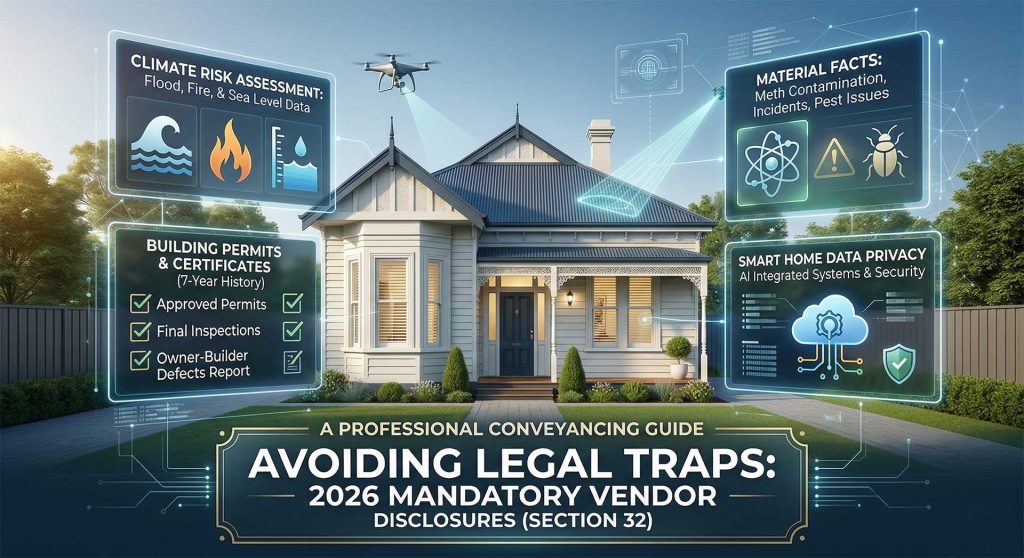
Mandatory Vendor Property Disclosures 2026: Avoiding Legal Traps for Victorian Sellers
Selling your property in 2026 requires more than just a “For Sale” sign. With stricter property disclosure requirements and new digital compliance standards, your Section 32 Vendor Statement is your most critical legal defense.
What is a Section 32 Vendor Statement in 2026?
In Victoria, the Sale of Land Act 1962 mandates that a seller must provide a signed Vendor Statement (Section 32) to a prospective buyer before the contract is signed. By 2026, this document has evolved to include detailed digital certifications and broader “material fact” disclosures that were previously optional.
At AJ Conveyancing Pty Ltd, we ensure your Section 32 is bulletproof, protecting you from the risk of a buyer rescinding the contract at the eleventh hour.
New: The “Full Property Disclosure Requirements 2026” Era
Regulatory shifts in early 2026 have introduced several new layers to the disclosure process:
- AML/CTF Compliance (Effective July 2026): As part of Australia’s new Anti-Money Laundering regime, vendors must now undergo stricter Digital Verification of Identity (VOI).
- Climate Risk Assessments: Following the 2025 Victorian Government Disclosure Statements, many buyers now expect (and some local councils mandate) disclosures regarding flood and fire overlays updated for 2026 weather patterns.
- Smart Home Data Privacy: If your home features integrated AI or smart security systems, you must disclose the data handover process to the new owner.
The 7-Year Rule: Building Permits and Owner-Builders
One of the most common “traps” for sellers involves recent renovations. If you have completed building works within the last seven years, you must disclose:
- All building permits issued under the Building Act 1993.
- For owner-builders: An Owner-Builder Defects Report (less than 6 months old) and evidence of Owner-Builder Warranty Insurance if the value of works exceeded $16,000.
Failing to include these permits is a “get out of jail free” card for buyers, allowing them to terminate the sale without penalty.
The Danger of “Material Facts”
Victorian law now places a heavy emphasis on “Material Facts.” These are details that would influence a buyer’s decision to purchase. In 2026, this includes disclosing:
- Known drug residue (methamphetamine) contamination.
- Significant structural defects or pest infestations.
- Illegal building works (structures built without a permit).
- The existence of combustible cladding (especially for apartments and townhouses).
Consequences of an Incomplete Section 32
If your Section 32 is found to be inaccurate, misleading, or missing mandatory certificates, the consequences are severe:
“A buyer may have the legal right to rescind the contract at any time before settlement if the vendor has failed to provide a compliant Section 32.”
This could result in thousands of dollars in lost marketing costs, legal fees, and the potential for a lower sale price in a secondary listing.
Frequently Asked Questions – Property Disclosure Requirements 2026
How long is a Section 32 valid in 2026?
While there is no strict expiry date, most certificates within the document (like council rates and water) are only considered current for 60 to 90 days. We recommend updating your statement if your property remains on the market for more than three months.
Do I need to disclose a death at the property?
Under ‘Material Fact’ guidelines, certain types of deaths (such as those involving a violent crime) must be disclosed to potential buyers to avoid claims of misleading conduct.
Can I prepare my own Section 32?
Technically yes, but it is highly discouraged. The complexity of 2026 digital lodgments and the liability of missing a mandatory overlay make professional preparation by a licensed conveyancer (Licence 000990L) essential.